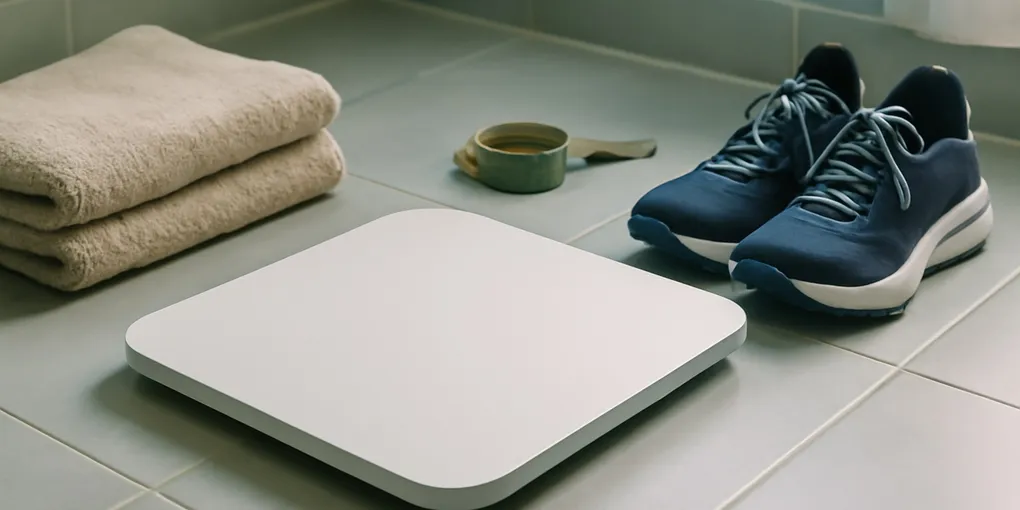
Withings Body Smart Scale Review: Useful Trend Tool or Too Much Body-Comp Guesswork?
ReviewWithings Body Smart scale
Best app-connected trend scaleBest Use: Weight trends, multi-user syncing, and a polished health-app workflow
$90-120
Quick picks
| Product | Key Specs |
|---|---|
| See price on Amazon |
|
| See price on Amazon |
|
| See price on Amazon |
|
Product availability, certifications, and retailer details can change; check the current Amazon page before buying.
Bottom line
The Withings Body Smart is a good smart scale if you want automatic weight trends, multi-user support, and a polished app. It is not a precise body-composition lab. Buy it for the weight trend and workflow, not because a bathroom scale can tell you exactly how much muscle you gained this month.
If automatic syncing is the main reason you will weigh consistently, Search Amazon for Withings Body Smart scale. If you only need body weight, Search Amazon for basic digital bathroom scales and spend the difference elsewhere. For another health-tech review that separates training data from medical certainty, see our Fitbit Charge 6 review.
Quick verdict
- Buy it if you want Wi-Fi syncing, app trends, multiple users, and a quiet way to keep weight data out of a spreadsheet.
- Skip it if body-fat percentage is the main feature you care about.
- Choose a basic scale if extra app metrics make you check the number more often than is useful.
Practical score
| Factor | Weight | Score | Rationale |
|---|---|---|---|
| Research | 30% | 5.8 | Weight tracking is straightforward; consumer body-composition estimates are much less settled. |
| Evidence Quality | 25% | 5.4 | Bioelectrical impedance can be influenced by hydration, timing, and device assumptions. |
| Value | 20% | 7.0 | Strong value if app syncing improves consistency; poor value if you ignore the app. |
| User Signals | 15% | 7.2 | Setup, Wi-Fi reliability, multi-user detection, and app clarity drive long-term satisfaction. |
| Transparency | 10% | 6.6 | Withings explains features better than many generic scales, but shoppers still need to understand estimate limits. |
| Composite | 100% | 6.2 | A useful trend scale with over-interpretable body-composition extras. |
What the Withings Body Smart is best at
The strongest reason to buy this scale is friction reduction. Step on, let it sync, and look at weekly or monthly trends rather than a single noisy weigh-in. That is more useful than manually typing numbers into an app for two weeks and quitting.
The scale also fits households better than many bargain models because the app ecosystem is built around profiles and trend charts. If two people use the scale, automatic assignment matters. If the assignment is wrong, the data becomes worse than no data, so check the app during the first week.
The body-composition caveat
Smart scales estimate body composition using bioelectrical impedance analysis. That method sends a small electrical signal through the body and uses equations to estimate body water and tissue compartments. It is convenient, but consumer devices can be affected by hydration, exercise timing, meals, skin temperature, and algorithm differences.
A 2021 review in Nutrients describes bioelectrical impedance as useful but sensitive to assumptions and standardization (https://www.ncbi.nlm.nih.gov/pmc/articles/PMC8122302/). The National Institute of Diabetes and Digestive and Kidney Diseases also treats waist measurement and health context as part of weight-related risk assessment rather than relying on one number alone (https://www.niddk.nih.gov/health-information/weight-management/adult-overweight-obesity/health-risks).
Use body-fat percentage as a rough trend at most. If it jumps after a salty dinner or hard workout, that is not instant fat gain or muscle loss.
Setup details that affect accuracy
Put the scale on a hard, flat surface such as tile, sealed wood, or firm vinyl. Carpet makes readings less reliable, and moving the scale between rooms can shift the baseline. Weigh at a consistent time, ideally after using the bathroom and before breakfast, if daily weighing is appropriate for you. Do not compare a morning fasted reading with a post-workout evening reading and call the difference progress.
Keep feet placed consistently. Clean, dry feet matter for impedance readings. If the app offers athlete or special modes, read what they do before enabling them. More settings do not automatically mean more truth. Use the same account profile, check that household members are assigned correctly, and replace batteries before weak power starts creating sync gaps.
Who should not buy it
Skip the Withings Body Smart if scale numbers trigger anxiety, disordered eating patterns, or compulsive checking. A smart scale makes data easier to collect, which can be a downside. Also skip it if you want medical-grade body composition. A bathroom scale is not a DEXA scan.
Pregnant users, people with implanted medical devices, and people managing medical conditions should follow clinician guidance on whether bioimpedance features are appropriate. If in doubt, choose a basic weight-only scale or disable body-composition features if the product allows it.
Withings versus a cheaper smart scale
The cheaper scale may be enough if all you need is Bluetooth weight logging. Withings is more attractive when app polish, Wi-Fi syncing, and household use matter. The price difference is not buying laboratory accuracy; it is buying workflow.
Before buying any smart scale, check whether it syncs with the app you actually use. Apple Health, Google Fit, Fitbit, and other integrations vary by region and app version. If syncing breaks your routine, the smartest hardware becomes a basic scale with more frustration.
Better ways to use the data
Look at a seven-day or monthly trend instead of a single day. Pair weight with waist measurement, training performance, sleep, and how clothes fit. A Search Amazon for body measurement tape is cheap context for people who can use measurements without obsessing.
If you are changing nutrition or training, decide in advance how often you will review data. Daily collection with weekly review is often calmer than reacting to every morning number.
Withings Body Smart FAQ
Does the Withings Body Smart replace a doctor visit?
No. It is a consumer trend tool. Use clinical measurements and medical advice for diagnosis, medication decisions, pregnancy, edema, unexplained weight change, or eating-disorder concerns.
Should athletes trust the muscle-mass number?
Treat it as a rough trend only. Hydration and training timing can move impedance estimates, and consumer scales do not directly measure muscle tissue.
Is Wi-Fi better than Bluetooth on a scale?
Wi-Fi is usually better for friction because data can sync without opening the phone app at the scale. Bluetooth is fine if you do not mind manual app steps.
Frequently Asked Questions
- It can be useful for weight trends if used consistently on a hard flat floor. Body-composition estimates from consumer bioimpedance scales are less reliable and should be treated as trend clues.
- It is worth considering if automatic syncing helps you stay consistent. If extra metrics make you anxious or obsessive, a basic scale or no scale is a better choice.
- No consumer smart scale should be treated as a precise body-fat test. Hydration, timing, skin temperature, and device algorithms can all move the estimate.