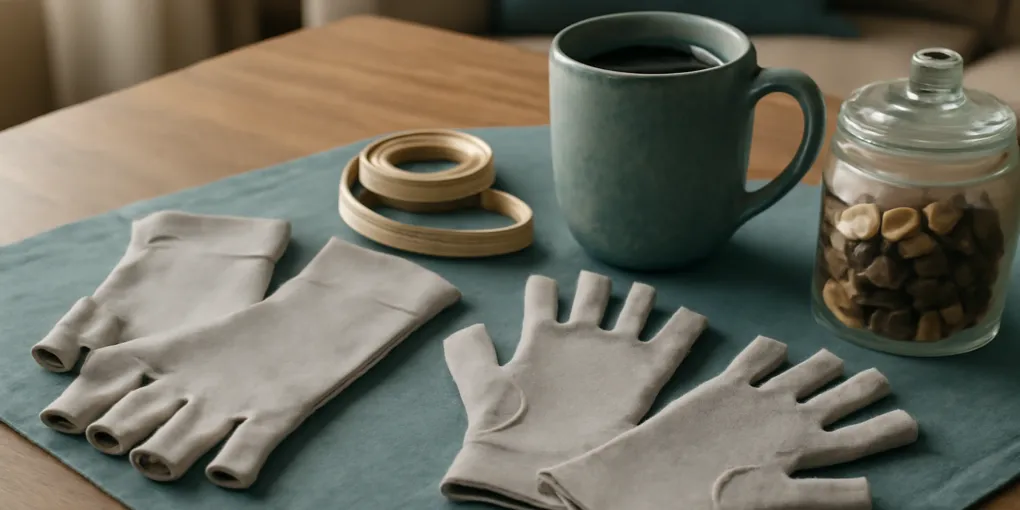
Compression Gloves for Hand Arthritis: Warmth and Comfort, Not a Joint-Fixing Device
Buyer's GuideIMAK Arthritis Gloves
Soft everyday fingerless optionBest Use: Light compression and warmth during typing or household tasks
Quick picks
| Product | Key Specs |
|---|---|
| See price on Amazon |
|
| See price on Amazon |
|
| See price on Amazon |
|
Product availability, certifications, and retailer details can change; check the current Amazon page before buying.
Quick pick
Buy a soft fingerless glove such as IMAK when warmth, light pressure, and keyboard dexterity are the goal. Consider Dr. Frederick’s Original when size and finger-length options fit better. Choose a warmer Thermoskin-style glove when cold aggravates symptoms and extra bulk will not interfere with the task.
Do not buy compression gloves expecting them to realign joints, halt rheumatoid arthritis, rebuild cartilage, or reliably reduce swelling. The largest pragmatic trial of arthritis gloves found no clinically important benefit from the compression component beyond a looser placebo glove. Some users still value warmth, touch protection, and the reminder to pace painful hands. Those are valid comfort benefits if the glove fits, but they call for a modest budget and a good return policy.
Choose by task, not diagnosis label
| Your main problem | Best starting design | Feature to prioritize | Reason to skip or return it |
|---|---|---|---|
| Hands ache while typing | Thin fingerless glove | Flat seams and free fingertip movement | Seams press into the palm or keys feel harder to control |
| Cold makes fingers stiff | Thermal glove | Warmth without sweating | Heat increases swelling or skin irritation |
| Knuckles feel tender during chores | Soft full-back glove | Padding from contact, washable fabric | Grip becomes less secure on tools or cups |
| Fingers swell unpredictably | Adjustable or very light glove | Easy removal and several sizes | Rings or glove edges leave deep marks |
| Numbness, color change, or circulation disease | Do not self-fit tight compression | Clinical or hand-therapy advice | Compression can obscure or worsen a nerve or blood-flow problem |
A glove that helps at a keyboard may be unsafe for wet dishes. A glove comfortable at rest may bunch around finger joints while driving. Name the task before choosing the product.
What the evidence actually says
The A-GLOVES randomized trial compared correctly fitted compression arthritis gloves with loose-fitting placebo gloves in people with rheumatoid arthritis or inflammatory arthritis. At 12 weeks, the trial did not find clinically important differences in hand pain, stiffness, or function attributable to compression. The economic analysis also found that the compression gloves were not cost-effective compared with placebo gloves.
That result does not mean every wearer imagines relief. Both groups could experience warmth, attention, expectation, and protection from light contact. It means shoppers should not pay a premium for claims that precise compression has been proven to control arthritis symptoms.
Evidence also varies by arthritis type. Rheumatoid arthritis is an inflammatory autoimmune disease; hand osteoarthritis involves joint degeneration and other tissue changes. A retail listing that says arthritis may not distinguish them. Treatment decisions for inflammatory arthritis should not be reduced to a glove.
Compare the named options
IMAK Arthritis Gloves are a common thin, fingerless format. Check Imak Arthritis Gloves on Amazon. Verify the manufacturer’s size chart, material blend, washing instructions, and whether the listing is a pair. Reviews about comfort can help identify seam problems, but they cannot establish medical effectiveness.
Dr. Frederick’s Original sells several glove lengths and packages. Check Dr Fredericks Original Arthritis Gloves on Amazon. Confirm the exact model because copper-infused wording, finger length, and bundle count can vary. Copper in fabric has not been shown to treat arthritis. Judge the glove as fabric, fit, warmth, and light pressure.
Thermoskin Arthritis Gloves use a thicker thermal concept. Check Thermoskin Arthritis Gloves on Amazon. They may fit someone whose hands feel better when warm, but thicker material can interfere with fine motor tasks and can become uncomfortable in warm rooms.
Measure before ordering
Use the exact chart for the exact glove. Manufacturers may size from palm circumference, palm width, hand length, or a combination. “Medium” is not standardized.
Measure at the time of day when symptoms are typical. If swelling varies substantially, a fixed glove may alternate between loose and constricting. Ask the manufacturer what to do between sizes rather than automatically choosing the smaller size for more compression.
After putting the glove on, check:
- Fingertips remain their usual color and temperature.
- There is no new tingling, numbness, or throbbing.
- The wrist edge does not roll into a narrow band.
- Seams do not cross a tender knuckle or press into the thumb web.
- You can make a gentle fist without fabric cutting into finger creases.
- You can remove the glove without force when hands are tired.
Deep marks that persist, increasing pain, cool fingertips, color change, or numbness mean the fit is wrong.
Fingerless, full-finger, or thermal?
Fingerless gloves preserve tactile feedback for phones, keyboards, buttons, and medication packaging. The tradeoff is no warmth or pressure over the distal finger joints. Look at where the finger openings end; a tight hem directly over a swollen joint can be worse than no glove.
Full-finger gloves provide more warmth but reduce touch and may make slippery objects harder to control. They are a poor choice around open flame, rotating machinery, or tasks where loose fabric can catch.
Thermal gloves emphasize heat. Warmth may temporarily ease stiffness for some people, but swollen, acutely inflamed joints may not welcome extra heat. Test the glove during one specific low-risk task rather than wearing it all day on the first attempt.
Grip and seam checks for daily tasks
Before keeping a glove, test it with the objects that create the buying need. Pick up a ceramic mug with both dry and slightly damp hands, type a paragraph, button a shirt, open the usual medication container, and hold a phone for five minutes. Stop if the glove reduces grip security or catches on a control. A fabric marketed for compression may be smooth enough to make glass and polished tool handles less secure.
Turn the glove inside out and inspect the seam route. A thick thumb seam can press directly over the thumb-base joint that often hurts in hand osteoarthritis. Finger hems should end between tender joints rather than across them. Also check whether the pair is truly symmetrical; twisted stitching can make one hand comfortable and the other unusable. These construction details predict daily wear better than copper content, compression percentages that lack a test method, or a large review count.
A seven-day usefulness test
The glove should earn its place by improving a real task. Pick one task, such as 30 minutes of keyboard work, fastening buttons in the morning, or holding a book.
For three sessions without the glove and three comparable sessions with it, record pain during the task, task time, dropped objects or mistakes, and skin response. Keep medication and task setup stable when practical. If the glove feels pleasant but makes the task slower or less safe, use it for rest rather than work.
Wash it according to instructions before the return window closes. Some fabrics shrink, seams twist, and elastic changes after washing. A glove that only fits before its first wash is not a durable purchase.
When to ask a hand therapist
An occupational or hand therapist can recommend splints, joint-protection strategies, adaptive utensils, heat use, exercises, and task modifications based on the affected joints. A thumb CMC brace, resting hand splint, or ring splint does a different job from a soft compression glove.
Seek assessment for rapidly increasing swelling, a new hot red joint, sudden weakness, locking or triggering, persistent numbness, fingertip color changes, a wound, or loss of hand function. Rheumatoid arthritis that remains active needs disease-modifying treatment review. A glove must not disguise progression while joints are being damaged.
What to avoid
Avoid copper, magnet, or infrared claims that add cost without showing a relevant clinical outcome. Avoid one-size-fits-all products when compression depends on fit. Avoid wearing damp gloves, which can irritate skin. Remove gloves before cooking near flame, using power tools, or any task where fabric may snag.
People with Raynaud phenomenon, peripheral neuropathy, reduced sensation, significant vascular disease, severe swelling, fragile skin, or recent hand surgery should obtain advice before using tight gloves. Monitor skin carefully if dexterity makes removal difficult.
What to buy today
- Buy IMAK: you want a thin fingerless glove for warmth and ordinary desk tasks.
- Buy Dr. Frederick’s: its exact size and finger length fit better, with a return policy that permits a real task test.
- Buy Thermoskin: warmth is the main benefit and thicker fabric will not compromise grip.
- Buy a different orthosis: a specific unstable thumb or finger joint needs support rather than general compression.
- Buy nothing yet: symptoms include numbness, color change, a hot swollen joint, rapid progression, or an unclear diagnosis.
FAQ
Do compression gloves reduce hand swelling?
They may feel supportive, but strong evidence for a clinically important compression-specific benefit is lacking. Do not use them to manage unexplained or rapidly changing swelling without assessment.
Can I sleep in arthritis gloves?
Only if the product instructions and your clinician allow it, and the fit causes no numbness, color change, or skin pressure. Night use makes it harder to notice an overly tight glove.
Are copper gloves better?
Copper-infused fabric has not been shown to treat arthritis. Choose based on fit, seam placement, warmth, washability, and return terms.
Sources
- A-GLOVES randomized controlled trial of compression gloves: https://pmc.ncbi.nlm.nih.gov/articles/PMC7897565/
- NICE, rheumatoid arthritis in adults management guideline: https://www.nice.org.uk/guidance/ng100
- American College of Rheumatology/Arthritis Foundation, hand osteoarthritis treatment guideline: https://pubmed.ncbi.nlm.nih.gov/31908149/
- Versus Arthritis, hand and wrist pain information: https://versusarthritis.org/about-arthritis/conditions/hand-and-wrist-pain/
- Related reading: knee unloader braces for osteoarthritis.