Slant Board Calf Stretch Protocol: How to Use Incline Stretching Without Irritating Achilles
ProtocolQuick picks
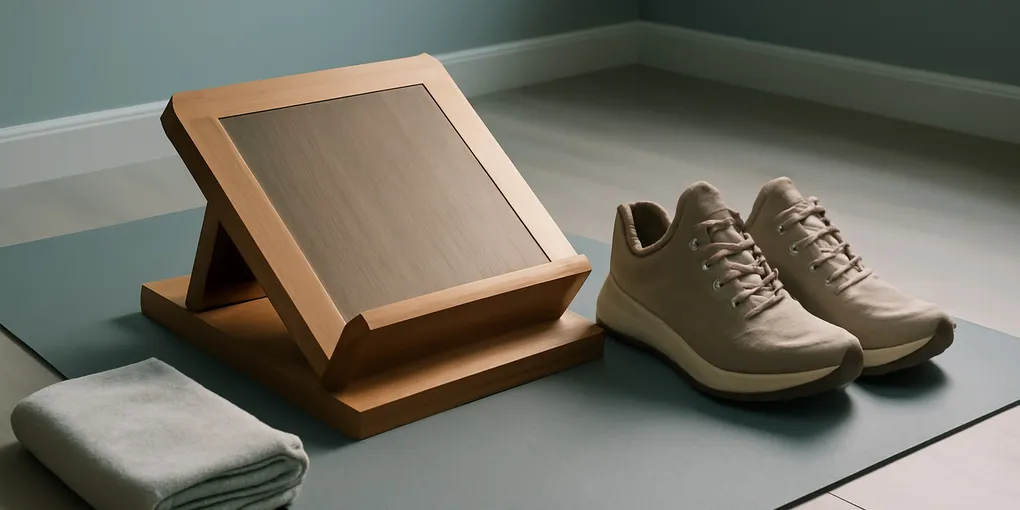
Adjustable wooden slant board
★ Top pick Best first pick- Best Use: Home calf stretching with stable incline choices
- Caveat: Check weight rating, traction surface, and angle range
Foldable slant board
Best small-space option- Best Use: Apartments, offices, and travel storage
- Caveat: Hinges and locks must feel stable under body weight
Non-slip wedge calf stretcher
Best simple option- Best Use: Lower-angle stretching without moving parts
- Caveat: One fixed angle may be too steep or too mild
Bottom line
A slant board is useful when it lets you stretch the calf and ankle at a repeatable, controllable angle. It becomes a problem when the incline is too steep, the surface is slippery, or the stretch is treated like a pain contest. Beginners should start at the lowest useful angle, hold steady pressure, and judge the response later that day, not just during the stretch.
For most homes, an Search Amazon for adjustable wooden slant board is the best first pick because angle choice matters. Small spaces may prefer a Search Amazon for foldable slant board. If you want no hinges or setup, a Search Amazon for non-slip wedge calf stretcher can work if the fixed angle suits you.
Quick picks
- Search Amazon for Adjustable wooden slant board — best first purchase because you can lower the angle on sore days and progress slowly.
- Search Amazon for Foldable slant board — best for apartments or office mobility breaks if the locking mechanism is sturdy.
- Search Amazon for Non-slip calf stretch wedge — best simple option when you want a fixed incline with fewer moving parts.
The beginner protocol
Use shoes for the first week unless the board surface is clearly comfortable barefoot. Place the board near a wall, rail, or counter so balance is not the limiting factor. Set the incline to the lowest angle that creates a mild calf stretch without heel lift, arch cramping, toe gripping, or Achilles pinching.
Hold 20-30 seconds per side for two or three rounds. Keep the knee straight for gastrocnemius emphasis, then try a gentler bent-knee version for soleus if it feels comfortable. Breathe normally and keep pressure steady. Do not bounce.
Use the protocol three or four days per week at first. Daily stretching is not automatically better if the Achilles or plantar fascia feels irritated afterward. The useful signal is a calf that feels easier to move later, not a stretch that feels intense in the moment.
Progression rules
Progress one variable at a time. First make the low angle feel easy. Then add a little time. Only then increase incline. If you increase angle and time together, you will not know which change caused soreness.
For runners, do not place a hard slant-board session immediately before speed work. The calf-Achilles complex already handles high load during running. Use the board after an easy run, during a mobility session, or on a separate day. If you are also doing eccentric calf raises for Achilles stiffness, keep stretching gentle so the combined load does not flare symptoms.
For general mobility, pair the board with easy ankle rocks, short walks, or light strength work. If your goal is loaded walking or hill training, compare this with the weighted vest walking protocol and keep new calf demands separated.
Practical score
| Factor | Weight | Score | Rationale |
|---|---|---|---|
| Research | 30% | 5.8 | Calf stretching and ankle mobility are plausible, but slant-board-specific outcome evidence is limited. |
| Evidence Quality | 25% | 5.0 | Benefits depend on symptoms, dose, strength work, and whether the issue is mobility or tendon load tolerance. |
| Value | 20% | 7.2 | A durable board is inexpensive and repeatable compared with bulky mobility equipment. |
| User Signals | 15% | 6.8 | Users like the obvious stretch, but many choose angles that are too aggressive. |
| Transparency | 10% | 6.5 | Better listings disclose angle range, dimensions, traction surface, and weight rating. |
| Composite | 100% | 6.1 | Useful for controlled calf mobility work, not a cure for tendon or foot pain. |
Clinical stretching evidence is mixed by condition, but calf and plantar fascia programs commonly emphasize tolerable loading and consistency rather than aggressive pain. A randomized trial comparing plantar fascia-specific stretching with Achilles tendon stretching for chronic plantar fasciitis highlights that stretch target and symptom context matter (https://pubmed.ncbi.nlm.nih.gov/12851352/). Achilles tendinopathy exercise reviews also emphasize progressive loading and symptom-guided progression rather than passive stretching alone (https://pubmed.ncbi.nlm.nih.gov/37628466/).
Buying details that matter
Angle range matters more than maximum steepness. A board that starts around a mild incline and progresses gradually is more useful than one that only offers dramatic angles. Beginners, older users, and people with tendon sensitivity should be able to choose an easy setting.
Traction matters. The foot platform should not feel slick with shoes or socks. Rubber strips, textured surfaces, and stable feet are worth checking. If the board slides on tile, use it on a mat or choose a different product.
Width and weight rating matter for confidence. A narrow wedge can be fine for one foot but awkward for two-foot standing stretches. A flimsy foldable board may look convenient but feel unstable when you shift weight.
Who should be cautious
Be cautious with acute Achilles pain, recent calf strain, plantar fascia flares, neuropathy, balance problems, recent surgery, unexplained swelling, or pain that changes gait. A slant board should not turn sharp pain into a daily ritual.
Stop if symptoms radiate, the Achilles feels hot or swollen, the arch cramps repeatedly, or pain worsens after sessions. Stretching is not automatically harmless just because it is low-tech.
FAQ
How long should I hold a slant board calf stretch?
Start with 20-30 seconds per side for two or three rounds. Increase time only if the stretch feels tolerable during the session and normal later that day.
What angle should beginners use?
Use the lowest useful incline first. A mild angle that you can relax into is better than a steep angle that makes the foot, calf, or Achilles guard.
Can a slant board fix Achilles pain?
No. It can support mobility work for some people, but Achilles pain may need load management, strengthening, footwear changes, or clinician-guided rehab.
Should my heel stay down?
For a standard calf stretch, keep the heel supported and avoid bouncing. If the heel lifts or the arch cramps, lower the angle.