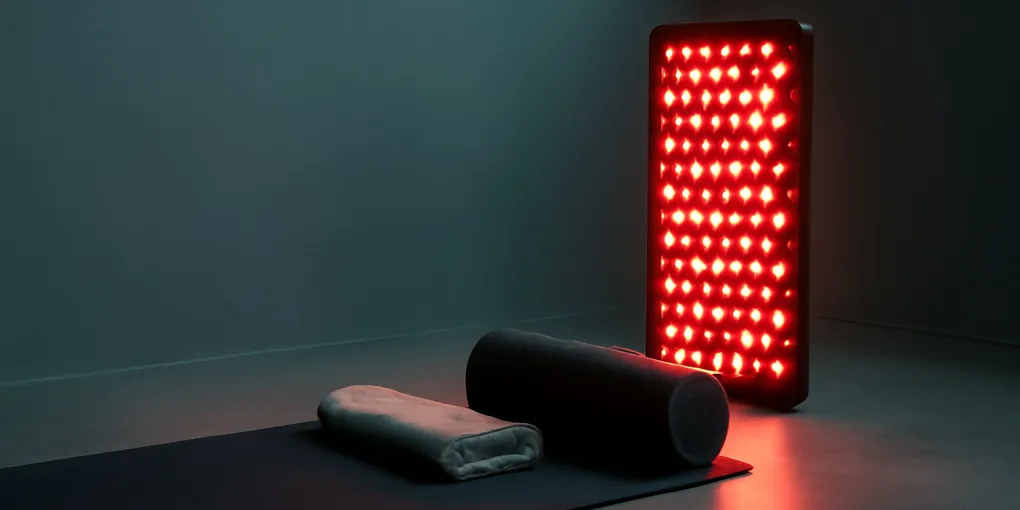
Red Light Therapy Panels for Soreness: Evidence, Dose Reality, and Buyer Cautions
Evidence ExplainerQuick picks
Desktop red and near-infrared panel
★ Top pick Best small-area starter- Best Use: Knee, calf, shoulder, elbow, or one small target area
- Caveat: Check wavelength, irradiance claims, distance, and return policy
Half-body red light therapy panel
Best for larger coverage- Best Use: Back, hips, legs, or multiple target areas in one session
- Caveat: Needs floor space, mounting, and stricter eye-safety habits
Red light therapy eye protection goggles
Safety add-on- Best Use: Bright panels, face-adjacent sessions, or shared household use
- Caveat: Goggles do not make unsafe device instructions safe
Bottom line
Red light therapy panels are most plausible for readers who want a low-effort recovery add-on for a specific area, such as a sore knee, calf, elbow, or shoulder. They are not a shortcut for sleep, progressive training, adequate protein, rehab loading, or medical evaluation of persistent pain.
If you want to experiment without turning the room into a clinic, start with a Search Amazon for desktop red and near-infrared panel. If the target area is the back or both legs, a Search Amazon for half-body panel is more practical but costs more and needs space. For bright panels, add Search Amazon for red light therapy eye protection rather than assuming squinting is enough.
Quick picks
- Search Amazon for Desktop red/NIR panel — best first purchase when one joint or small muscle group is the real target.
- Search Amazon for Half-body red light panel — best for back, hips, or larger leg coverage if you have room and will actually set it up.
- Search Amazon for Red-light eye protection — sensible add-on for bright panels, face-adjacent use, and households where someone might look into the LEDs.
What the evidence can and cannot say
Red and near-infrared light therapy is usually discussed under photobiomodulation. The research is more serious than generic wellness-light marketing, but it is not a single treatment with one dose. Studies vary by wavelength, power, treatment time, distance, target tissue, timing, and outcome.
A meta-analysis of randomized trials on low-level laser therapy for muscular performance and soreness recovery found that study parameters and timing matter, which is exactly why consumer-panel claims need restraint (https://pubmed.ncbi.nlm.nih.gov/34428975/). Sports and recovery studies also suggest that dose can change results, but translating a clinic protocol to a consumer panel is not automatic.
That means the honest buyer claim is narrow: a panel may be worth trying if you can follow a consistent dose, track a specific outcome, and avoid using it to delay assessment of worsening pain. It should not be sold as guaranteed muscle repair, injury reversal, testosterone support, or whole-body transformation (https://pubmed.ncbi.nlm.nih.gov/34428975/).
For more mechanical recovery tools, compare the tradeoff with foam rolling for soreness and mobility or the Theragun Mini review. Red light is quieter and passive; massage and mobility tools give more immediate sensation but can be overused, while photobiomodulation studies remain dose- and protocol-sensitive (https://pubmed.ncbi.nlm.nih.gov/34428975/).
Practical score
| Factor | Weight | Score | Rationale |
|---|---|---|---|
| Research | 30% | 6.0 | Photobiomodulation has legitimate musculoskeletal literature, but consumer panel protocols vary widely (https://pubmed.ncbi.nlm.nih.gov/34428975/). |
| Evidence Quality | 25% | 5.5 | Dose, wavelength, and study heterogeneity limit simple product claims. |
| Value | 20% | 5.8 | A small panel can be reasonable; large panels get expensive quickly. |
| User Signals | 15% | 6.2 | Users like passive sessions, but adherence drops when setup is awkward. |
| Transparency | 10% | 5.0 | Better brands disclose wavelength and usage distance; many listings lean on vague recovery language. |
| Composite | 100% | 5.7 | A cautious experiment for targeted soreness, not a core recovery requirement. |
How to choose a panel
First decide the body area. A desktop panel is enough for an elbow, knee, calf, or shoulder. A half-body panel is easier for the back, hips, or both legs. Buying a large panel for one elbow is usually wasted money; buying a tiny panel for the whole back usually creates awkward sessions and inconsistent distance.
Look for disclosed wavelengths, commonly red around 630-660 nm and near-infrared around 810-850 nm. Also look for recommended distance and session duration. Be skeptical of listings that promise deep repair but do not state basic specifications. Irradiance claims are hard for consumers to verify, so return policy and conservative dosing matter.
Mounting matters. A panel that requires balancing on a chair is a poor fit for repeat use. If the target is the lower leg, a tabletop stand may be enough. If the target is the back, a door mount or floor stand may be worth more than slightly higher output.
A cautious first-month protocol
Pick one target area and one outcome before starting. Examples: morning knee stiffness, calf soreness after intervals, or shoulder discomfort after pressing. Do not use five body areas at once and then guess what changed.
Use the manufacturer’s conservative starting guidance. Keep distance and time consistent. Start with a few sessions per week rather than daily maximum sessions. If skin feels irritated, eyes feel strained, headaches appear, or pain worsens, stop and reassess.
Track the outcome in plain language: session date, distance, time, body area, and symptom rating before the next workout or next morning. If there is no meaningful change after a month of consistent use, the product may not be worth keeping.
Safety and skip rules
Do not stare into bright LEDs. Follow device instructions for eyewear, distance, and session length. Be cautious with photosensitizing medications, active cancer treatment, eye disease, pregnancy, seizure disorders, unexplained skin lesions, or any condition where heat or light exposure has been restricted by a clinician.
Do not use a red light panel over an acute injury that is swelling, hot, severely painful, or function-limiting in place of medical evaluation. Pain that changes your gait, wakes you at night, follows trauma, or includes neurological symptoms needs a different decision than buying a recovery gadget.
FAQ
Does red light therapy work for muscle soreness?
Some photobiomodulation research supports modest effects in pain or recovery contexts, but consumer panel results depend heavily on dose, distance, wavelength, body area, and consistency (https://pubmed.ncbi.nlm.nih.gov/34428975/).
What wavelengths should I look for?
Many panels use visible red around 630-660 nm and near-infrared around 810-850 nm. Listings should disclose wavelengths and usage distance clearly.
Is a bigger panel always better?
No. Bigger panels cover more area, but a small panel can be more practical if you only treat one knee, calf, elbow, or shoulder.
Do I need eye protection?
Bright panels and face-adjacent sessions deserve caution. Follow device instructions, avoid staring into LEDs, and use protective eyewear when appropriate.