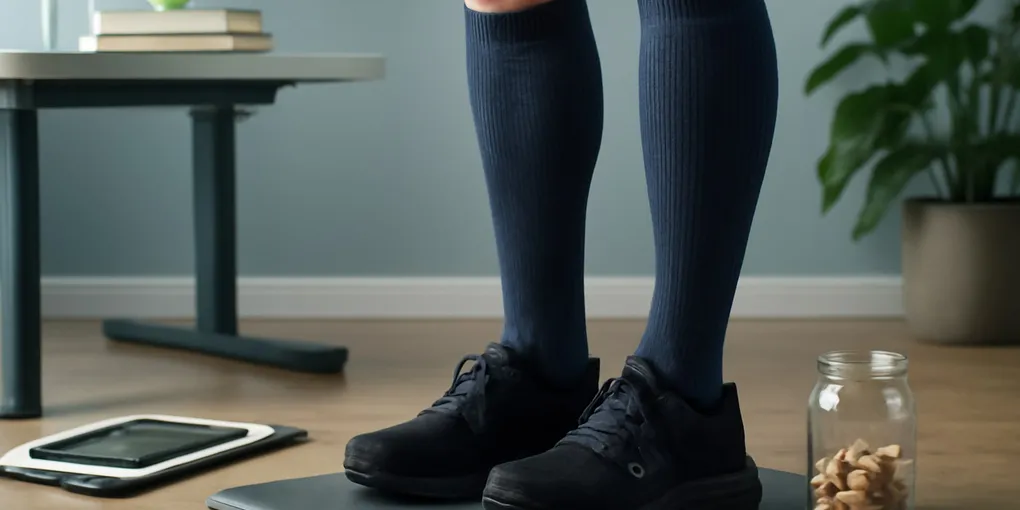
Compression Socks for Standing Desk Work: Helpful Leg Support or Office Wellness Hype?
Evidence ExplainerQuick picks
Mild graduated compression socks, 15-20 mmHg
★ Top pick Best cautious start- Best Use: Healthy adults who stand for long work blocks and want mild calf support
- Caveat: Sizing by calf and ankle measurement matters more than shoe size
Cushioned compression socks for work shoes
Best for hard floors- Best Use: Standing desk users, nurses, retail workers, and walkers who also need shoe comfort
- Caveat: Thicker socks can make tight shoes worse
Bottom line
Compression socks can be a reasonable comfort tool for standing desk work if you choose mild graduated pressure, measure your calf, and treat them as support rather than a circulation cure. Start by searching Amazon for 15-20 mmHg graduated compression socks if your problem is tired calves after long standing blocks. Do not jump straight to high-pressure medical garments without clinician guidance.
The strongest compression evidence is not about making office workers more productive. It comes from medical and travel contexts, including venous symptoms and clot-risk prevention. A Cochrane review found compression stockings reduce symptomless deep vein thrombosis during long flights, but that does not mean every standing desk user needs tight socks (Cochrane Database Syst Rev. 2021; PMID: 33878207). For office comfort, the practical question is narrower: do mild socks reduce calf heaviness without causing numbness, skin irritation, or shoe-pressure problems?
Quick picks
- Choose mild 15-20 mmHg graduated socks if you are a healthy standing-desk user testing calf comfort for the first time.
- Choose cushioned work compression socks if hard floors and thin shoes make your feet feel beat up before your calves do.
- Skip compression self-experiments if swelling is sudden, one-sided, painful, or paired with skin color changes.
What compression socks can and cannot do
Graduated socks are tightest at the ankle and usually ease upward toward the calf. That gradient can help limit pooling and swelling in some people. It cannot fix poor shoe fit, a floor that is too hard, or a standing plan that never includes walking. If your standing desk routine leaves your feet sore, also compare the load-management idea in our lacrosse-ball foot mobility protocol: small checks after short blocks beat chasing discomfort.
Mild over-the-counter socks often list 15-20 mmHg. Moderate socks often list 20-30 mmHg. Higher pressure is more medical and less forgiving. If you have peripheral artery disease, diabetes with neuropathy, active skin wounds, severe swelling, one-sided calf pain, or a history of clots, ask a clinician before experimenting.
Fit checklist
- Measure ankle and calf circumference, not just shoe size.
- The cuff should not dig a ring into the skin.
- Toes should stay warm and normal-colored.
- Remove the socks if you feel numbness, tingling, new pain, or skin irritation.
- Wash and dry as directed because stretched elastic changes compression.
How to judge compression socks for standing work
For standing-desk use, score socks on practical fit and modest claims.
- Research, 30%: Does the product use real graduated pressure ranges rather than vague tightness language?
- Evidence quality, 25%: Are claims limited to support, swelling comfort, or travel/work fatigue rather than curing vascular disease?
- Value, 20%: Are you buying enough pairs to rotate and wash without relying on worn-out elastic?
- User signals, 15%: Do reviews from people with similar calf sizes mention all-day comfort?
- Transparency, 10%: Are pressure range, fiber blend, length, and sizing chart easy to find?
A standing-desk protocol that makes socks more useful
Use compression socks with movement breaks. Try 30 to 45 minutes standing, two to five minutes walking, then sit for a block. Add a soft mat only if it does not make your balance lazy or your shoes unstable. Calf raises, ankle circles, and short walks are more physiologically relevant than standing perfectly still for hours.
How to choose pressure and length
For office standing, knee-high socks are usually the practical choice. They support the ankle and calf without adding thigh sizing problems. Mild 15-20 mmHg compression is enough for most healthy users who are experimenting with comfort. If you are buying for a diagnosed vein condition, pregnancy swelling, post-surgical instructions, or clot-risk management, use the pressure range your clinician recommends instead of copying a product review.
The label should state a pressure range, not just “firm support.” It should also include a sizing chart with ankle and calf measurements. If you are between sizes, do not automatically size down. Too-tight socks can create pressure marks, toe numbness, or skin irritation. Search Amazon for cushioned graduated compression work socks if your standing desk setup includes hard floors or thin work shoes.
How to test them during a workday
Use a half-day trial first. Put the socks on in the morning, wear shoes that still have toe room, and check your feet after two to three hours. Good signs are normal warmth, normal color, and less calf heaviness by the end of a standing block. Bad signs are tingling toes, new foot pain, itchy skin, a cuff groove that lasts, or socks that make you avoid walking because your shoes feel tight.
Compression also works better when paired with calf-muscle movement. Standing still in expensive socks is still standing still. Set a timer for short walks, ankle pumps, or calf raises. If symptoms are one-sided, sudden, painful, or associated with swelling and warmth, do not troubleshoot with socks.
Best fit
Compression socks make the most sense for a healthy worker who already tolerates normal walking but ends long standing blocks with heavy, tired calves. They make less sense as a fix for foot pain from bad shoes, numbness from nerve symptoms, or swelling that appears suddenly on one side.
FAQ
What pressure should I start with for office standing?
For healthy adults using socks for comfort, 15-20 mmHg is the most sensible starting range. Use higher pressure only when a clinician recommends it or you already tolerate compression well.
Are compression socks safe to wear all workday?
They can be for many healthy users when sized correctly, but they should not cause numb toes, skin color changes, pain, or deep cuff marks. Remove them if any of those happen.
Do compression socks replace walking breaks?
No. Socks may help with calf heaviness, but standing still is still static loading. Walking breaks and position changes remain the foundation.
Sources
- Clarke MJ, Broderick C, Hopewell S, et al. Compression stockings for preventing deep vein thrombosis in airline passengers. Cochrane Database Syst Rev. 2021. PMID: 33878207. https://pubmed.ncbi.nlm.nih.gov/33878207/
- MedlinePlus patient guidance on compression stockings: https://medlineplus.gov/ency/patientinstructions/000597.htm