Quick picks
Hyperice Normatec 3 Legs
★ Top pick Premium recovery-boot benchmark- Why consider it: A premium named option to compare for athletes who will use boots weekly and want established category support.
FIT KING leg air massager
Lower-cost powered alternative- Why consider it: A cheaper powered category option for comfort sessions, with less sport-specific polish than premium recovery boots.
Bottom line
Compression boots fit a narrow buyer: runners, court-sport athletes, frequent travelers, or high-volume lifters who already tolerate leg compression and will use the sleeves several times per week. The strongest buyer case is comfort and consistency, not a guarantee that muscles repair faster. If a 20-minute session helps you sit still, prop your legs on the sofa, and avoid adding another hard workout, the purchase has a clearer role.
The price is the hard part. A premium set such as the Hyperice model can cost several hundred dollars, so search Amazon for Hyperice Normatec 3 Legs only if the use case is frequent. If you mostly want lower-leg squeeze during travel or after standing, search Amazon for graduated athletic compression socks before buying powered boots.
Quick picks
- Premium benchmark: search Amazon for Hyperice Normatec 3 Legs if you train often, want a known recovery-boot category leader, and can justify the price.
- Lower-cost powered option: search Amazon for FIT KING leg air massagers if the goal is a comfort squeeze rather than a premium sport-recovery ecosystem.
- Cheapest first test: search Amazon for graduated athletic compression socks if travel swelling or long standing is the main issue.
What compression boots do
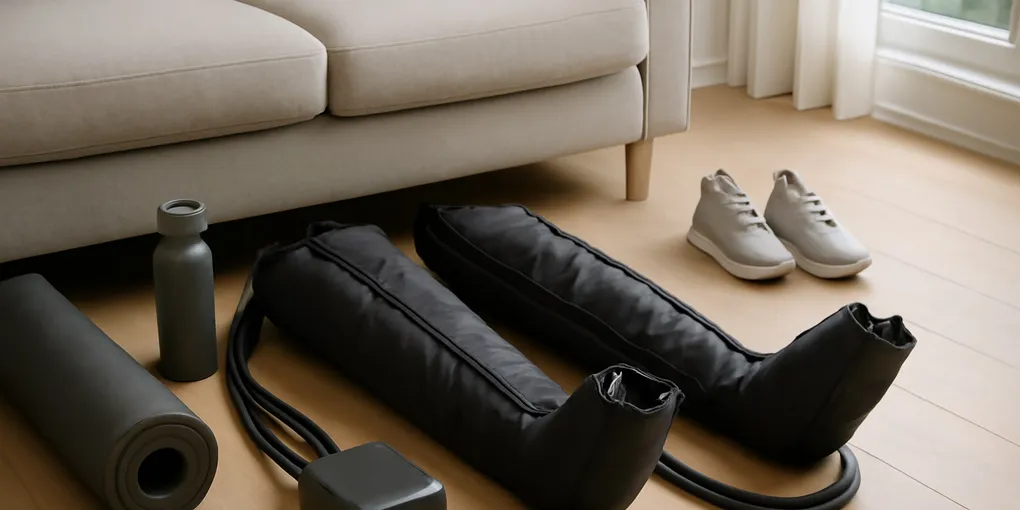
Recovery boots use sleeves with air chambers that inflate and deflate around the legs. The sensation is a moving squeeze rather than a static sock-like pressure. Many athletes use them while sitting or lying down after training.
The plausible benefits are fluid movement, comfort, and perceived leg freshness. That does not mean every marketing claim is established. Soreness, performance, inflammation, and readiness are not the same outcome. A device can make legs feel better without meaning the next workout should be harder.
Evidence in plain English
Research on pneumatic compression and athletic recovery is mixed because studies vary by protocol, pressure, timing, training type, and outcome. Some users report lower soreness or improved subjective recovery. Objective performance changes are less consistent.
That means the buyer question is practical: will you use the boots often enough, at a pressure that feels good, after training that actually leaves your legs heavy? If the answer is yes and the budget is reasonable, the product can make sense. If you expect a device to erase poor sleep, too much intensity, or under-fueling, skip it.
How to judge the purchase
Treat compression boots as a comfort device first and a performance device second. The evidence is strongest for subjective recovery signals, so the purchase only makes sense when the use pattern is specific: heavy leg training, long runs, tournaments, travel swelling, or standing-heavy work that leaves your legs noticeably heavy.
The buyer threshold is higher than it is for socks. A powered boot set needs repeat use, a pressure range you can tolerate, sleeve sizing that matches your legs, and a setup simple enough that you will actually run sessions. If the main goal is occasional flight swelling or mild end-of-day leg fatigue, compression socks are the more rational first test.
Who should consider them
Consider boots if you train legs often, run long distances, play tournaments, travel after events, or stand for work and already know compression feels good. They are more defensible when several people in a household will use them or when you can test them during a return window.
They also fit athletes who need a recovery boundary. Sitting in boots for 20 minutes can stop the pattern of adding more work to solve fatigue. That behavioral effect may be as useful as the squeeze.
Who should skip or ask first
Do not use compression boots as a self-treatment for unexplained leg swelling, calf pain, sudden asymmetry, or suspected clotting problems. People with a history of blood clots, peripheral vascular disease, uncontrolled heart failure, neuropathy, open wounds, or pregnancy-related circulation concerns should ask a clinician before using powered compression.
Skip them if you hate sitting still, dislike leg pressure, or would need financing to buy them. Recovery basics are still cheaper: sleep, sensible training load, protein, carbohydrates around hard sessions, and easy days that are actually easy.
Buying criteria
Sizing is first. Boots that are too short miss the target area; boots that are too tight can create pressure hot spots. Check inseam or height guidance, thigh circumference, and whether wide or tall sizes exist.
Pressure control is second. You want small steps and a low starting setting. More pressure is not automatically better. A painful squeeze can create guarding, numbness, or skin irritation.
Controls and storage are third. A simple controller, clear chamber sequence, and easy cleaning matter more than flashy app features. If setup takes ten minutes, the boots will live in a closet.
Compression boots versus socks
Compression socks are cheaper, portable, and easier to wear during travel. They provide static graduated pressure rather than intermittent pneumatic compression. They are the better first purchase if the problem is mild swelling after flights or standing.
Boots are more of a session-based recovery tool. You use them while seated, often after training. They may feel more relaxing, but they cost more and are less useful away from home.
For other recovery tools, compare the buyer logic with our Theragun Mini review and cold plunge protocol. Those tools also work best when matched to a specific recovery problem instead of used as wellness trophies.
FAQ
Do compression boots actually speed muscle recovery?
They may improve perceived soreness or heaviness for some users, but that is not the same as proven faster tissue repair. Treat them as a comfort and recovery-routine tool unless a clinician has prescribed compression for a specific condition.
How much pressure should recovery boots use?
Start low to moderate. Pain, numbness, tingling, throbbing, or skin color change means the pressure is wrong and the session should stop. If a lower setting does not feel comfortable, the product is a poor fit.
Who should not use compression boots without medical advice?
People with clotting history, vascular disease, uncontrolled heart failure, unexplained leg swelling, neuropathy, open wounds, or pregnancy-related concerns should ask a clinician first. Those are not normal buyer-fit details.
Sources and further reading
- A Sports Medicine review discusses recovery techniques and performance outcomes after exercise.
- A PubMed-indexed review covers intermittent pneumatic compression and recovery-related outcomes.
- MedlinePlus explains deep vein thrombosis symptoms and when leg swelling needs care.