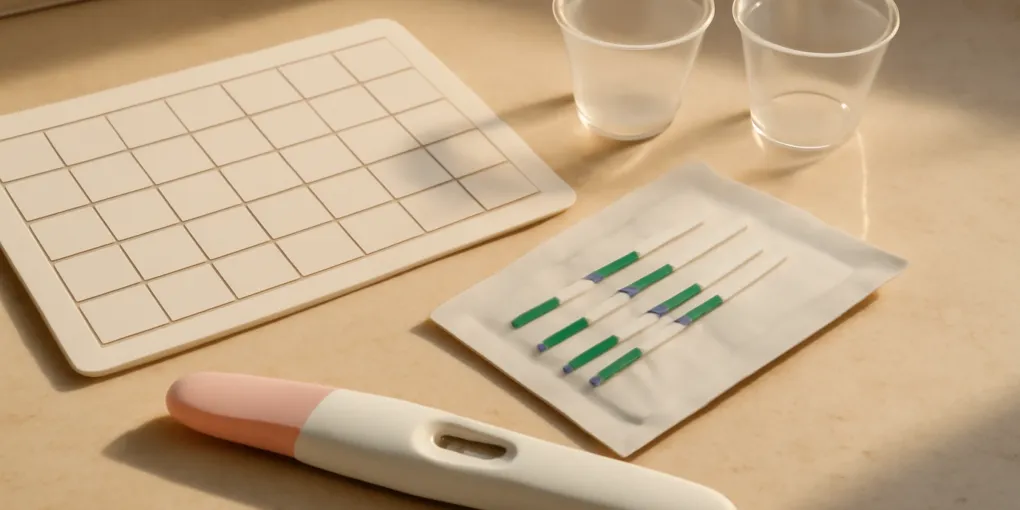
Ovulation Test Kits: LH Strips vs Digital Monitors for Trying to Conceive
Buyer's GuideEasy@Home Ovulation Predictor Kit
Best low-cost repeat testingBest Use: Regular or variable cycles when several test days may be needed
Quick picks
| Product | Key Specs |
|---|---|
| See price on Amazon |
|
| See price on Amazon |
|
| See price on Amazon |
|
Product availability, certifications, and retailer details can change; check the current Amazon page before buying.
Quick pick
Buy inexpensive LH strips if you can compare two lines and may need to test for more than a few days. They provide the best cost control for long or variable cycles. Choose a basic Clearblue Digital kit if line interpretation makes you second-guess every result. Consider Clearblue Advanced Digital only if a longer estimated fertile window is worth the extra cost and you will follow that model’s start-day and testing instructions exactly.
An ovulation test predicts a luteinizing hormone, or LH, surge. It does not prove that an egg was released, measure egg quality, diagnose infertility, or replace evaluation when cycles are absent or pregnancy is not occurring on the expected timeline.
The buying decision in one table
| Your situation | Best starting format | Why | What can go wrong |
|---|---|---|---|
| Cycles are fairly regular and budget matters | LH strip kit | Many tests per box, easy to test across several days | Faint lines are normal; only the brand’s positive threshold counts |
| You repeatedly misread strip darkness | Basic digital LH test | Converts the test into a simple device result | More expensive, and the holder may only work with matching sticks |
| You want more warning before the LH surge | Advanced digital monitor | Some models track an estrogen metabolite before detecting LH | A longer displayed window is still an estimate, not confirmed ovulation |
| Cycles are very irregular or PCOS is suspected | Start with clinician guidance, then use strips selectively | Repeated LH elevation can make home results difficult to interpret | Buying more tests does not solve anovulation or clarify the diagnosis |
| You need proof that ovulation occurred | Do not rely on an LH kit alone | Confirmation may involve cycle history, progesterone testing, ultrasound, or basal temperature patterns | A positive predictor can occur without subsequent ovulation |
LH strips: the value choice
Urine LH strips are usually the right first purchase. A kit often includes enough strips to test once daily across the expected window and more frequently as the line darkens. The control line shows that the test ran. The test line must meet the manufacturer’s threshold, commonly as dark as or darker than the control, to count as positive. A visible but lighter line is not automatically a surge.
The practical advantage is volume. Someone with a 34-day cycle may need a wider testing window than someone with a predictable 27-day cycle. Low-cost strips let that person start early without rationing five expensive test sticks. For the Easy@Home Ovulation Predictor Kit, Check Easy At Home Ovulation Predictor Kit on Amazon, but check the current box count, expiration date, test sensitivity, seller, and instructions rather than assuming every listing is identical.
Strip kits are a poor fit when vision, color perception, lighting, or anxiety makes line comparison unreliable. Apps that photograph strips may help organize results, but lighting and camera processing can change the apparent ratio. The manufacturer’s visual instructions remain the standard for that product.
Basic digital tests: pay for a clearer readout
A basic digital ovulation test detects LH and displays the result without asking you to judge line darkness. That simplicity is the product benefit. It does not make the biological prediction more certain than an appropriately used strip. You are paying for interpretation and handling.
For current Clearblue Digital Ovulation Test kits, Check Clearblue Digital Ovulation Test on Amazon. Verify whether the listing is the basic digital model or the advanced model because their hormones, displays, and instructions differ. Also check how many sticks are included and whether a reusable holder is supplied.
Choose digital when a clear device result will prevent repeated retesting or arguments with yourself about borderline lines. Skip it when you have long cycles and the limited stick count would force another box before the surge appears.
Advanced digital tests: a different signal, not merely a nicer screen
Advanced digital systems may track both an estrogen metabolite and LH. Rising estrogen can identify additional high-fertility days before the LH surge produces a peak result. That can be useful for timing intercourse across a broader window. It can also create confusion if the reader expects every high result to turn into peak on a fixed schedule.
For current Clearblue Advanced Digital kits, Check Clearblue Advanced Digital Ovulation Test on Amazon. Read the exact model instructions before the cycle begins. Starting on the wrong day, switching holders, missing tests, or testing at inconsistent times can affect the algorithm’s baseline and display sequence.
Do not pay more solely because “advanced” sounds more accurate. Pay more if the additional fertile-window information changes what you can realistically do.
When to start and how to avoid wasting strips
Use the start-day table in the specific kit, based on usual cycle length. Cycle day one is generally the first day of full menstrual flow, not a day of light spotting, but follow guidance from your fertility clinician if your bleeding pattern is unusual.
Testing rules differ. Some brands advise a particular time window or urine-hold period. Excess fluid before testing can dilute urine. Other kits, especially algorithm-based digital models, may specify first urine after the longest sleep. Do not combine instructions remembered from one brand with a different brand’s test.
A practical strip routine is:
- Estimate the earliest plausible surge from several prior cycle lengths, not just the average.
- Begin on the kit’s recommended cycle day.
- Test at a consistent time and avoid excessive fluid immediately beforehand.
- As the strip darkens, use the frequency allowed by the instructions if catching a short surge matters.
- Record the result, cycle day, and any fertility treatment instructions.
- Stop according to the kit guidance after a clear positive or after the recommended testing window.
PCOS and irregular cycles change the interpretation
People with polycystic ovary syndrome may have higher baseline LH, multiple apparent surges, or long cycles without ovulation. A box of strips can show hormone activity without answering whether ovulation followed. Digital algorithms can also produce extended high readings in some irregular patterns.
If cycles are frequently longer than 35 days, absent, highly variable, or accompanied by symptoms suggesting PCOS or another endocrine issue, make the medical appointment rather than repeatedly buying larger boxes. An LH kit can still be part of a clinician-guided plan, but it is not the diagnostic plan.
Fertility medications also change the rules. Human chorionic gonadotropin trigger injections can affect some urine tests. Clomiphene, letrozole, and monitored cycles come with clinic-specific timing. Follow that protocol instead of a general product article.
What a positive test means
A positive result usually indicates an LH surge and an upcoming fertile window. Ovulation often follows after the surge, but timing varies and ovulation is not guaranteed. The American Society for Reproductive Medicine describes urinary LH kits as a way to identify the LH surge that precedes ovulation. For conception timing, sperm survival means intercourse before ovulation matters, not only after the strongest test.
If you are avoiding pregnancy, an LH test is not a stand-alone contraceptive method. A negative test does not establish a safe day because the surge may be missed and sperm can survive for several days.
When to stop shopping and seek evaluation
ASRM generally recommends infertility evaluation after 12 months of regular unprotected intercourse when the female partner is under 35, after 6 months at age 35 or older, and more promptly over 40 or when a known risk factor exists. Earlier evaluation is also appropriate for irregular or absent cycles, known or suspected endometriosis, tubal or uterine disease, recurrent pregnancy loss, prior gonadotoxic treatment, or suspected male-factor infertility.
Bring the cycle log, test photos if helpful, medication list, and both partners’ relevant history. Do not let a monthly positive LH test postpone semen analysis or a broader evaluation.
What to avoid
Avoid expired strips, opened moisture-damaged pouches, unverified resellers, and listings that promise pregnancy from a test kit. Do not compare darkness across brands because sensitivity and dye differ. Do not reuse a digital holder with incompatible sticks. Most importantly, do not interpret repeated positive results as proof of repeated ovulation.
What to buy today
- Buy LH strips: you want the lowest cost per test and can interpret lines.
- Buy basic digital: uncertain lines are the main obstacle and your testing window is predictable.
- Buy advanced digital: earlier fertile-window information is genuinely useful and the higher recurring cost is acceptable.
- Buy nothing yet: cycles are absent or markedly irregular, you are on a monitored treatment protocol, or the fertility-evaluation timeline has already been reached.
FAQ
Are digital ovulation tests more accurate than strips?
They can be easier to read, but both formats depend on urine hormone detection and correct timing. A digital display reduces line-interpretation error; it does not confirm ovulation.
Can an ovulation test be positive when I do not ovulate?
Yes. An LH surge can occur without subsequent ovulation, and PCOS or other hormonal patterns can complicate results.
Should I test twice a day?
Some strip users test more often as the line darkens, but follow the exact kit instructions. More testing is not always useful, especially with algorithm-based digital holders.
Can I use an ovulation test to avoid pregnancy?
Not by itself. A negative result can miss a surge and does not account for sperm survival. Use a validated contraceptive method or a properly taught fertility-awareness method.
Sources
- American Society for Reproductive Medicine, optimizing natural fertility: https://www.asrm.org/practice-guidance/practice-committee-documents/optimizing-natural-fertility-a-committee-opinion-2021/
- American Society for Reproductive Medicine, fertility evaluation of infertile women: https://www.asrm.org/practice-guidance/practice-committee-documents/fertility-evaluation-of-infertile-women-a-committee-opinion-2021/
- Clearblue, digital ovulation test instructions and product details: https://www.clearblue.com/ovulation-tests/digital
- Clearblue, advanced digital ovulation test details: https://www.clearblue.com/ovulation-tests/advanced-digital
- FDA, home-use test overview and safe use principles: https://www.fda.gov/medical-devices/in-vitro-diagnostics/home-use-tests
- Related reading: fertility supplement protocol and best CoQ10 for egg quality.