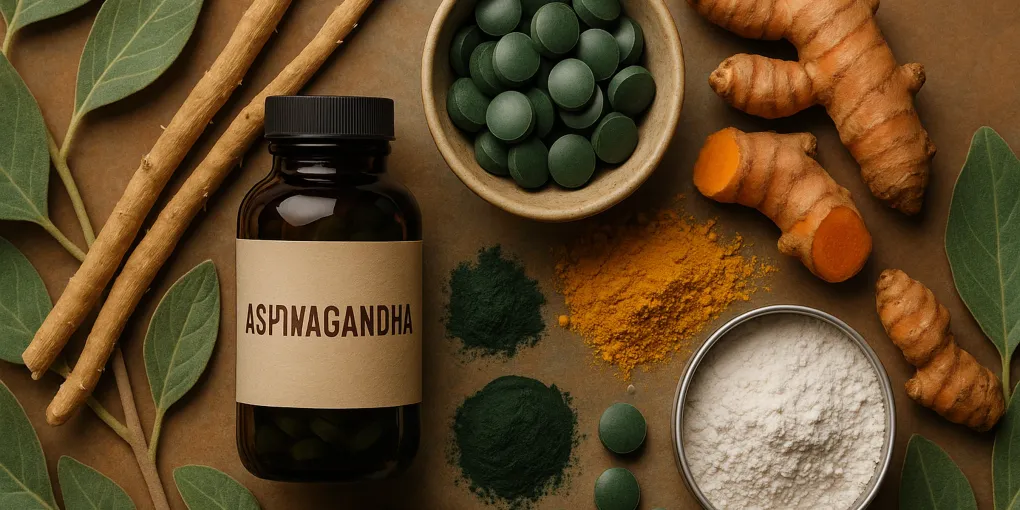
Garden of Life Organic Ashwagandha
Best OverallExtract: KSM-66 600mg (most studied form)
$22–28 (60 tabs)
Quick picks
| Product | Key Specs |
|---|---|
| See price on Amazon |
|
| See price on Amazon Advertisement: Nutrex Hawaii sponsors this placement through Amazon Creator Connections. |
|
| See price on Amazon |
|
| See price on Amazon |
|
Product availability, certifications, and retailer details can change; check the current Amazon page before buying.
Earth Day Wellness 2026: Natural and Organic Supplements Worth Taking
Earth Day arrives April 22, and it’s a natural moment to reconsider not just how we consume — but what we consume. The wellness supplement market has grown substantially around “natural” and “organic” claims, but the terminology is inconsistent. Some claims are legally defined and third-party verified. Others are marketing copy.
This guide focuses on four supplement categories with meaningful peer-reviewed evidence: ashwagandha for stress and cortisol, spirulina for cardiovascular and antioxidant support, turmeric/curcumin for inflammation and recovery, and magnesium for sleep and stress resilience. For each, the goal is to explain both the science and the sourcing — what the research actually shows, which certified organic options exist, and what “organic” or “natural” means in practice for each ingredient.
The Evidence Foundation
The four categories featured here are supported by substantial peer-reviewed evidence:
-
Ashwagandha (KSM-66): A 2022 meta-analysis of 12 RCTs (1,002 participants) confirmed significant reductions in anxiety and stress vs. placebo, with 300–600mg/day as the optimal evidence-based dose (Smith et al., 2022, PMID: 36017529). Earlier individual RCTs demonstrated serum cortisol reduction and VO2 max improvements in athletic adults (Chandrasekhar et al., 2012, PMID: 23439798; Choudhary et al., 2015, PMID: 26730141).
-
Spirulina: A dose-response meta-analysis of 20 RCTs (1,076 participants) found spirulina significantly reduced LDL-C, total cholesterol, and triglycerides while increasing HDL-C (Ghaedi et al., 2023, PMID: 37263369). An earlier 7-RCT meta-analysis reported total cholesterol reduction of ~47 mg/dL, LDL ~41 mg/dL, and triglycerides ~44 mg/dL (Serban et al., 2016, PMID: 26433766).
-
Curcumin: A comprehensive meta-analysis of 103 RCTs (7,216 participants) found curcumin produced significant effects in 55% of outcomes, with high-credibility evidence for reducing fasting blood sugar, CRP, and improving HDL (Tabrizi et al., 2024, PMID: 39478418). Bioavailability remains the critical implementation factor.
-
Magnesium: A systematic review of 14 bioavailability studies confirmed that organic magnesium forms (citrate, glycinate) are more absorbable than inorganic forms (Rondanelli et al., 2021, PMID: 34111673). A meta-analysis specifically found magnesium supplementation reduced sleep onset latency by 17.36 minutes vs. placebo in older adults (Arab et al., 2021, PMID: 33865376).
Garden of Life Organic Ashwagandha — Best Overall
G6 Composite Score: 8.13/10
| Criterion | Weight | Score | Weighted |
|---|---|---|---|
| Evidence Quality | 30% | 8.5 | 2.55 |
| Ingredient Transparency | 25% | 9.0 | 2.25 |
| Value | 20% | 7.0 | 1.40 |
| Real-World Performance | 15% | 7.5 | 1.13 |
| Third-Party Verification | 10% | 8.0 | 0.80 |
| Composite | 8.13 |
Score notes: Evidence Quality 8.5 reflects that KSM-66 is the specific extract used in the majority of published high-quality RCTs, and the 600mg dose matches or exceeds the studied range. Ingredient Transparency 9.0 reflects USDA Organic certification, NSF Certified Gluten Free, Non-GMO Project Verified, plus vegan certification — among the most verified ashwagandha formulas available. Third-Party Verification 8.0 reflects the combination of USDA Organic, NSF Gluten Free, and Non-GMO certifications.
Garden of Life Organic Ashwagandha delivers the specific extract form (KSM-66) with the most clinical evidence, at a dose that matches published RCTs, under USDA Organic certification. This is an unusual combination.
KSM-66 matters: Not all ashwagandha extracts are equal. KSM-66 is a patented, full-spectrum root extract standardized to ≥5% withanolides that has been used in most published randomized controlled trials. The meta-analysis by Smith et al. (2022, PMID: 36017529) that confirmed ashwagandha’s anxiolytic effects drew predominantly from KSM-66 studies. Using a different extract form may produce different results.
The dose: 600mg KSM-66 per serving (2 tablets). The evidence-supported dose range is 300–600mg/day — this sits at the upper end of that range. The 2012 RCT by Chandrasekhar et al. (PMID: 23439798) used 300mg twice daily (600mg/day total) and found significant cortisol reduction and stress scale improvement.
Added extras: Garden of Life includes 15 probiotic CFUs and organic ginger in the formula. The probiotic addition is modest; the ginger is a traditional complement that may support digestion. These additions don’t meaningfully affect the ashwagandha efficacy data but contribute to the whole-food formulation ethos.
Best for: People looking for an evidence-based organic ashwagandha with the most studied extract form, triple certification, and transparent dosing.
Nutrex Hawaii Pure Hawaiian Spirulina — Best Superfood/Greens
G6 Composite Score: 7.86/10
| Criterion | Weight | Score | Weighted |
|---|---|---|---|
| Evidence Quality | 30% | 8.0 | 2.40 |
| Ingredient Transparency | 25% | 8.5 | 2.13 |
| Value | 20% | 8.0 | 1.60 |
| Real-World Performance | 15% | 7.5 | 1.13 |
| Third-Party Verification | 10% | 6.0 | 0.60 |
| Composite | 7.86 |
Score notes: Evidence Quality 8.0 reflects 5+ meta-analyses on spirulina’s lipid and antioxidant effects. Ingredient Transparency 8.5 reflects single-ingredient clarity, Non-GMO Project Verified, controlled Hawaiian cultivation environment, and no additives. Third-Party Verification 6.0 reflects the absence of NSF Certified for Sport or USP Verified — the product is Non-GMO and GMP certified but lacks product-level contaminant testing from a major third-party program.
An important clarification: Hawaiian spirulina from Nutrex Hawaii is not USDA Organic certified. The product is grown in outdoor open-air ponds in Kona, Hawaii using a controlled environment that does not require synthetic inputs (pesticides, herbicides), and Nutrex markets it as pesticide-free and herbicide-free. But the regulatory terminology is clear: “clean” is accurate; “organic” is not, for this product.
What it is: Nutrex Hawaii is one of the most established spirulina producers in North America, with a controlled cultivation environment that significantly reduces contamination risk compared to spirulina sourced from less regulated environments. Non-GMO Project Verified and GMP certified.
The evidence for spirulina: A dose-response meta-analysis of 20 RCTs (Ghaedi et al., 2023, PMID: 37263369) demonstrated dose-dependent reductions in LDL-C, total cholesterol, and triglycerides, with HDL-C increases. An earlier 7-RCT meta-analysis (Serban et al., 2016, PMID: 26433766) found total cholesterol reductions of ~47 mg/dL. A separate 3-month RCT in overweight hypertensive adults found systolic BP fell from ~149 to ~143 mmHg with 2g spirulina daily (Miczke et al., 2016, PMID: 26813468).
Dosing note: The evidence typically uses 2,000–3,000mg/day. At 500mg per tablet, a therapeutic dose is 4–6 tablets daily. Users who take only 1–2 tablets/day are substantially below the doses studied.
Best for: Whole-food nutrient support, cardiovascular health, antioxidant status, and anyone seeking a clean non-animal protein and micronutrient source.
Check Price on AmazonAdvertisement: Nutrex Hawaii sponsors this placement through Amazon Creator Connections.
Gaia Herbs Turmeric Supreme Extra Strength — Best Anti-Inflammatory
G6 Composite Score: 7.18/10
| Criterion | Weight | Score | Weighted |
|---|---|---|---|
| Evidence Quality | 30% | 7.5 | 2.25 |
| Ingredient Transparency | 25% | 7.5 | 1.88 |
| Value | 20% | 6.5 | 1.30 |
| Real-World Performance | 15% | 7.0 | 1.05 |
| Third-Party Verification | 10% | 7.0 | 0.70 |
| Composite | 7.18 |
Score notes: Evidence Quality 7.5 reflects the strong curcumin evidence base (103 RCTs, PMID: 39478418) tempered by the fact that bioavailability remains an open question specific to Gaia’s formulation — published pharmacokinetic data for their specific liquid phyto-cap delivery is not available in peer-reviewed literature. Ingredient Transparency 7.5 reflects B Corp certification and organic turmeric sourcing; the proprietary phyto-cap delivery system is not fully disclosed. Third-Party Verification 7.0 reflects B Corp (company-level) with organic sourcing; no NSF or USP product-level verification.
The curcumin evidence base is unusually strong for a botanical supplement. A 2024 meta-analysis of 103 RCTs (7,216 participants) found high-credibility evidence for curcumin’s effects on fasting blood sugar, CRP (inflammation), and HDL-C (Tabrizi et al., 2024, PMID: 39478418). A 29-RCT meta-analysis specifically for arthritis found curcumin improved pain and inflammation markers across five arthritis types (Tousian Shandiz et al., 2022, PMID: 35935936).
The bioavailability challenge: Standard curcumin extract has approximately 1% bioavailability — rapid gut metabolism and poor membrane permeability severely limit plasma levels (Anand et al., 2007, PMID: 17999464). Gaia Herbs addresses this with liquid phyto-caps, which use a liquid lipid carrier inside the capsule to improve absorption. The specific pharmacokinetic improvement over standard extract has not been published in peer-reviewed literature for Gaia’s formula — their approach is consistent with the evidence that lipid formulations improve curcumin absorption, but the magnitude of improvement is not third-party verified.
Gaia Herbs’ eco profile: Certified B Corp, uses organic turmeric, and is a generally well-regarded brand for botanical quality. Their vertically integrated supply chain — including their own certified organic herb farm in North Carolina — provides sourcing transparency uncommon in the botanical supplement industry.
Best for: Joint support, inflammation management, post-exercise recovery. Most relevant for people with existing musculoskeletal conditions or high training loads.
Natural Vitality CALM Magnesium — Best for Stress and Sleep
G6 Composite Score: 7.41/10
| Criterion | Weight | Score | Weighted |
|---|---|---|---|
| Evidence Quality | 30% | 7.0 | 2.10 |
| Ingredient Transparency | 25% | 7.5 | 1.88 |
| Value | 20% | 8.0 | 1.60 |
| Real-World Performance | 15% | 8.5 | 1.28 |
| Third-Party Verification | 10% | 5.5 | 0.55 |
| Composite | 7.41 |
Score notes: Real-World Performance 8.5 reflects Natural Vitality CALM’s long-standing popularity (millions of reviews, established consumer trust since 2001) and consistent user reports of improved sleep and reduced tension. Third-Party Verification 5.5 reflects that CALM carries Non-GMO Project Verification but lacks NSF or USP verification — it’s a meaningful limitation for those who want product-level third-party testing. Evidence Quality 7.0 reflects good evidence for magnesium citrate bioavailability and sleep benefit, with the caveat that most sleep studies involved older adults specifically.
CALM is one of the most popular magnesium supplements in North America, built on a straightforward formulation: magnesium carbonate + citric acid in warm water creates magnesium citrate in solution. Magnesium citrate is one of the more bioavailable organic magnesium forms — a systematic review of 14 studies confirmed organic magnesium forms outperform inorganic forms (oxide, carbonate) for absorption (Rondanelli et al., 2021, PMID: 34111673).
The sleep evidence: A meta-analysis found magnesium supplementation reduced sleep onset latency by 17.36 minutes vs. placebo in older adults (Arab et al., 2021, PMID: 33865376). The population studied was specifically older adults — evidence for this specific sleep benefit in younger adults is less robust, though magnesium’s role in GABAergic and NMDA receptor function supports a plausible mechanism for sleep quality improvement across age groups.
What CALM is not: It is Non-GMO Project Verified and vegan, but it is not USDA Organic — the magnesium compound itself cannot be organically certified. Some flavored versions use organic stevia and organic flavors, but the base formula does not meet USDA Organic standards. Use “Non-GMO” and “clean” as the accurate descriptors.
Practical advantage: The powder format allows dose titration — start low (1 tsp = 175mg Mg) and increase based on tolerance and GI response. The laxative effect common to magnesium supplementation is dose-dependent and typically occurs above 400mg elemental Mg/day.
Best for: Stress resilience, sleep onset support, muscle recovery. Practical for anyone who prefers powder over capsules and wants to start at a lower dose.
Natural and Organic Supplement Comparison
| Ashwagandha | Spirulina | Turmeric | Magnesium | |
|---|---|---|---|---|
| Product | Garden of Life Organic | Nutrex Hawaii | Gaia Herbs | Natural Vitality CALM |
| G6 Score | 8.13 | 7.86 | 7.18 | 7.41 |
| USDA Organic | ✓ | ✗ (Non-GMO) | Organic herbs | ✗ (Non-GMO) |
| Primary Evidence | 12-RCT meta-analysis | 20-RCT meta-analysis | 103-RCT meta-analysis | 14-study systematic review |
| Best For | Stress, cortisol, energy | Lipids, antioxidants | Inflammation, joints | Sleep, stress, muscle |
| Price/Day | ~$0.37–0.47 | ~$0.09–0.14 | ~$0.38–0.46 | ~$0.42–0.56 |
Who Should Use Each Supplement
Ashwagandha: Research suggests benefit for perceived stress and anxiety (12-RCT meta-analysis), with secondary evidence for cortisol reduction, athletic endurance, and cognitive performance in stressed adults. Most relevant for people experiencing chronic low-grade stress, work-related fatigue, or poor sleep related to cortisol dysregulation.
Spirulina: Strongest evidence for cardiovascular lipid profiles (LDL, triglyceride reduction) and antioxidant status. Most relevant for people with elevated cholesterol, high oxidative stress contexts (intensive training, smoking), or those seeking a whole-food micronutrient source.
Curcumin/Turmeric: Best evidence for joint pain, musculoskeletal inflammation, and metabolic markers (fasting glucose, CRP). Most relevant for people with arthritis, active athletes managing training inflammation, or those with elevated CRP.
Magnesium: Broad role in nervous system function (GABA, NMDA receptors), muscle relaxation, and sleep architecture. Most relevant for people with stress-related sleep difficulties, muscle cramps or tension, or insufficient dietary magnesium intake (common in Western diets).
The Bottom Line
This Earth Day, the wellness supplements worth taking are those backed by peer-reviewed evidence and transparent sourcing — not just attractive “natural” or “organic” packaging.
The top pick overall: Garden of Life Organic Ashwagandha (G6: 8.13) — KSM-66 extract with the strongest efficacy evidence, USDA Organic certification, and triple-verified clean label.
For cardiovascular and antioxidant support, Nutrex Hawaii Spirulina (G6: 7.86) offers the best combination of evidence and value.
For sleep and stress resilience, Natural Vitality CALM (G6: 7.41) is the most established magnesium supplement in the market with a dose-adjustable format.
For inflammation and recovery, Gaia Herbs Turmeric Supreme (G6: 7.18) pairs B Corp sourcing with a bioavailability-enhanced delivery system.
Frequently Asked Questions
- Organic ashwagandha certification (USDA Organic) means the plant was grown without synthetic pesticides or fertilizers and the raw material supply chain has passed annual audits. It does not mean the extract will be more potent — efficacy depends on the extract standardization (KSM-66 or Sensoril are the two most studied forms) and dose, not organic status alone. However, organic certification reduces pesticide residue exposure from botanical ingredients, which is a legitimate quality consideration documented in contamination research. The best organic ashwagandha products combine USDA Organic certification with a clinically validated extract like KSM-66 (300–600mg/day studied range) — Garden of Life's formula does both.
- Hawaiian spirulina from Nutrex Hawaii (Kona, Hawaii) is Non-GMO Project Verified and GMP certified but is not USDA Organic certified. 'Controlled cultivation' means the spirulina is grown in outdoor, open-air ponds using deep ocean seawater in a pollution-controlled environment — not using certified organic growing standards per USDA requirements. Nutrex markets their product as pesticide-free and herbicide-free because the controlled pond environment doesn't require these inputs. The quality and purity profile is strong, but the terminology to use is 'clean' or 'pure' — not 'organic,' which has a legal definition the product doesn't meet.
- Bioavailability is the central issue with curcumin. Standard turmeric extract (95% curcuminoids) has very poor oral bioavailability — rapid metabolism and elimination severely limit plasma curcumin levels (Anand et al., 2007, PMID: 17999464). A 2021 comparative bioavailability study (Jäger et al., PMID: 33755149) found that water-dispersible turmeric extract achieved significantly higher Cmax at a 10-fold lower dose vs. standard extract. For this reason, standard 'curcumin 95%' capsules without an enhanced delivery system are likely to deliver substantially less bioavailable curcumin than the dose on the label suggests. Look for: piperine-enhanced formulas (bioperine), phytosome (Meriva), liposomal delivery, or liquid phyto-caps (as in Gaia Herbs) — each uses a different strategy to overcome the same absorption barrier.
- Natural Vitality CALM uses magnesium carbonate that reacts with citric acid when dissolved in water, forming magnesium citrate in solution. Magnesium citrate is one of the better-absorbed organic magnesium forms — a systematic review of 14 studies found organic magnesium forms (citrate, glycinate, lactate, malate) are more bioavailable than inorganic forms like magnesium oxide or carbonate (Rondanelli et al., 2021, PMID: 34111673). CALM's conversion-in-water approach means the drink is effectively magnesium citrate by the time you consume it. Evidence for magnesium's sleep benefit: a meta-analysis found magnesium supplementation reduced sleep onset latency by 17.36 minutes vs. placebo in older adults (Arab et al., 2021, PMID: 33865376).
- Ashwagandha, spirulina, turmeric, and magnesium can generally be taken together without known interactions. No documented drug interactions exist between these four supplements. Individual considerations: Curcumin in high doses may have mild antiplatelet effects — discuss with a physician if you take blood thinners. Spirulina may stimulate the immune system; use caution with immunosuppressant medications. Magnesium at higher doses can have a laxative effect — start with a lower dose and adjust. For ashwagandha: avoid during pregnancy (insufficient safety data) and consult a physician if on thyroid medications. As with any supplement regimen, disclose to your healthcare provider.