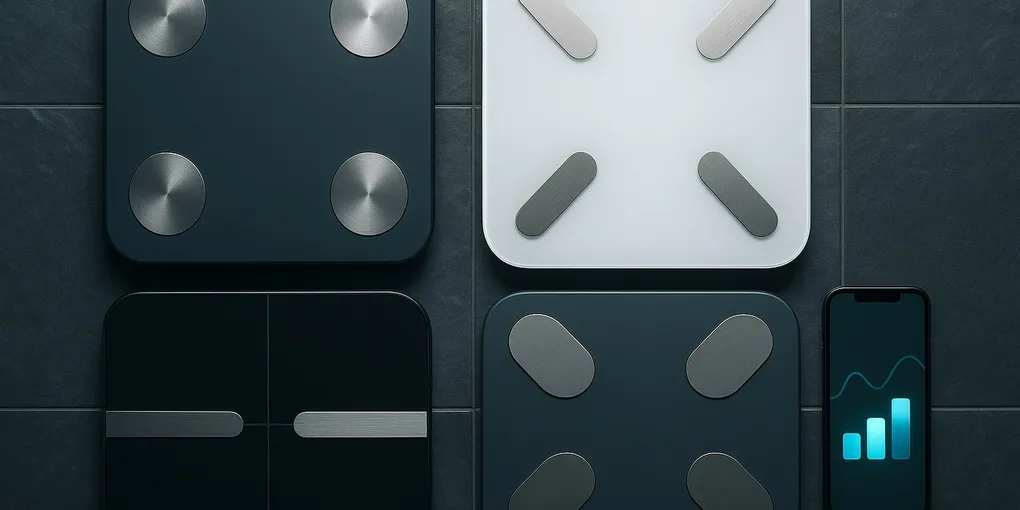
Withings Body+ Smart Scale
Best OverallConnectivity: Wi-Fi & Bluetooth
~$99
Quick picks
| Product | Key Specs | Trust signals | Evidence distinction | Pros / Cons |
|---|---|---|---|---|
| See price on Amazon |
|
|
|
|
| See price on Amazon |
|
|
|
|
| See price on Amazon |
|
|
|
|
| See price on Amazon |
|
|
|
|
| See price on Amazon |
|
|
|
|
Product availability, certifications, and retailer details can change; check the current Amazon page before buying.
Best Smart Scales for Body Composition Tracking 2026
A basic bathroom scale only tells you one thing: total body weight. But weight alone is a poor proxy for health. Two people at the same weight can have vastly different body compositions — one carrying excess fat, the other lean muscle mass. Smart scales use bioelectrical impedance analysis (BIA) to estimate body fat percentage, muscle mass, bone density, hydration, and more.
BIA works by sending a weak, safe electrical current through your feet and measuring resistance. Fat tissue, lean tissue, and body water conduct that current differently, so the scale estimates composition from an equation rather than directly measuring tissue. NCBI’s body-composition methods overview describes BIA as hydration- and protocol-sensitive, which is why a consistent home scale is best used for repeatable trends rather than DEXA-level diagnosis: https://www.ncbi.nlm.nih.gov/books/NBK279044/.
We compared current smart scales on measurement repeatability signals, app quality, connectivity, metric depth, privacy cues, and value. Here are the best product lanes for 2026.
Quick picks: best smart scales by use case
- Best overall: Withings Body+ Smart Scale. Pick this if you want Wi-Fi sync, strong app integrations, and less friction for daily trend tracking. Search Amazon for Withings Body+ Smart Scale
- Best value: Eufy Smart Scale P2 Pro. Pick this if you want a lower price, many tracked metrics, and do not mind opening the phone app for Bluetooth sync. Search Amazon for Eufy Smart Scale P2 Pro
- Best budget: Renpho Elis 2X Smart Scale. Pick this if the goal is simple weight-plus-body-fat trends under roughly $30 to $40. Search Amazon for Renpho Elis 2X Smart Scale
- Best for family profiles: QardioBase 2 Smart Scale. Pick this if household sharing, pregnancy mode, and non-number feedback matter more than the lowest price. Search Amazon for QardioBase 2 Smart Scale
Smart-scale availability and bundles change frequently. Verify the exact model name, app support, return window, and whether Wi-Fi is included before purchase. If you are deciding whether a scale belongs in a broader tracking setup, compare it with our Apple Watch health metrics review so you know which data should come from a wearable versus a bathroom scale.
How We Evaluated Smart Scales
Our research rubric prioritized consistency signals and real-world usability:
- Repeatability: We prioritized models with stable owner feedback, clear setup instructions, and fewer complaints about same-day measurement swings when used under consistent conditions.
- App experience: We evaluated onboarding speed, data visualization, third-party integrations, and whether the app respects privacy.
- Connectivity: Wi-Fi scales automatically log data regardless of whether your phone is nearby. Bluetooth scales require your phone to be in range.
- Metric usefulness: More metrics are not always better. We prioritized scales whose extra metrics (visceral fat, metabolic age, muscle balance) offer actionable insight rather than noise.
Important caveat: All consumer BIA scales have margins of error. Body fat estimates can deviate from DEXA by 3–8%. What matters is trend direction over weeks and months, not absolute accuracy on any single day.
Composite scoring breakdown for smart scales
We apply the same G6 weighted framework across device roundups so the top pick is not simply the most familiar brand or the scale with the longest feature list. The smart scale category is especially prone to overclaiming because most consumer devices estimate body composition indirectly. A model can be useful for trend tracking while still being weak as a single-read diagnostic tool, so our score rewards consistency, responsible app design, and transparent limitations.
| Factor | Weight | How it applies to smart scales |
|---|---|---|
| Research | 30% | Whether the underlying BIA method, weight sensors, and measurement conditions are supported by human validation research, including clinical reviews of body-composition methods. |
| Evidence Quality | 25% | Whether claims are limited to trend tracking and whether the brand avoids presenting body-fat estimates as clinical-grade results. |
| Value | 20% | Price relative to connectivity, multi-user support, app quality, and replacement/support expectations. |
| User Signals | 15% | Patterns in real-world owner feedback: sync reliability, app complaints, durability, and household sharing. |
| Transparency | 10% | Clear privacy terms, visible metric definitions, and honest disclosure that hydration, timing, and skin contact affect readings. |
| Evidence context: clinical reviews of bioelectrical impedance analysis note that hydration status, prediction equations, and measurement conditions can materially change body-composition estimates (review). |
For this update, we raised the importance of Wi-Fi sync and app reliability because a scale that fails to record consistently is less useful for week-to-week trend analysis. We also downgraded any product positioning that implies body-fat, water, or muscle readings should be interpreted as clinical measurements. The best use case is repeated measurement under the same conditions: same time of day, similar hydration, bare feet, and a stable surface. If a user needs medically precise body-composition assessment, DEXA, BodPod, or clinician-supervised methods remain more appropriate than any consumer bathroom scale (BIA method overview: https://www.ncbi.nlm.nih.gov/books/NBK279044/).
Practical buying guidance
Choose Wi-Fi if more than one person in the household will use the scale or if you want hands-off logging without opening the phone app every morning. Choose Bluetooth-only models when budget matters more than automation and you are comfortable launching the app during weigh-ins. Treat advanced metrics such as visceral fat, metabolic age, and protein percentage as directional heuristics rather than precise biomarkers; BIA estimates are sensitive to hydration, contact, and the prediction equation behind the app (Kyle et al., 2004). A cheaper scale used consistently can beat an expensive model that sits unused because the app is frustrating. A smart scale is most useful when it changes behavior without turning normal weight fluctuation into anxiety. Look for weekly averages, trend lines, and exportable data rather than judging success by one morning reading. If multiple people share the scale, confirm that the app can recognize users privately and avoid accidentally sending one person’s measurements into another profile. Privacy matters too: weight and body-composition records are health-adjacent data, so users should review account deletion, cloud sync, and third-party integration settings before connecting every wellness app by default. Use the scale as one signal alongside strength, waist measurement, training performance, sleep, and clinician-guided lab markers rather than as the single scoreboard for health. Recalibrate expectations if hydration, illness, travel, menstruation, or heavy training changes readings suddenly; those shifts often reflect water and glycogen, not true tissue change. Use-context source: bioelectrical impedance estimates are best interpreted as trend data because hydration and device equations can shift the result even when true tissue change is small (review).
Withings Body+ — Best Overall
The Withings Body+ has been the category leader for years, and for good reason. It combines reliable hardware with the most polished ecosystem in the consumer health space.
Key specs: Wi-Fi and Bluetooth connectivity, automatic multi-user recognition, 8 body composition metrics, and unlimited data storage in the Withings Health Mate app. The scale recognizes you automatically and sends data to the cloud without requiring your phone.
Why it wins: The Wi-Fi integration is the differentiator. With a Bluetooth-only scale, if you forget your phone in the other room, that weigh-in is lost. Withings captures everything. The Health Mate app integrates with Apple Health, Google Fit, Samsung Health, MyFitnessPal, and over 100 other services. Trend graphs are clean and informative.
The downside: At roughly $99, it costs twice as much as budget competitors. The glass platform can also feel cold during winter mornings.
Eufy Smart Scale P2 Pro — Best Value
Eufy (Anker’s home brand) delivers an impressive 16-metric scale at roughly half the price of the Withings Body+. The P2 Pro uses Bluetooth 5.0 and pairs with the EufyLife app.
Standout feature: The 3D virtual body model. After entering your height and seeing your weight distribution, the app renders a body silhouette that changes as you lose fat or gain muscle. It is a genuinely motivating visual feedback tool.
Metric depth: Beyond standard weight and body fat, the P2 Pro estimates basal metabolic rate (BMR), protein percentage, visceral fat, and body age. While not all of these are independently verifiable, the trends are directionally useful.
The tradeoff: Bluetooth-only connectivity means you need your phone within ~30 feet for every weigh-in. The scale supports up to 16 profiles, making it suitable for large households.
Renpho Elis 2X — Best Budget
Renpho dominates the budget smart scale market, and the Elis 2X is their most refined model yet. At around $30, it tracks 13 body composition metrics with surprising accuracy for the price.
Real-world performance: Owner feedback commonly praises the Elis 2X for consistent weight readings at a low price. Treat its body-fat and muscle estimates as trend lines rather than DEXA replacements, especially after salty meals, hard training, alcohol, or travel.
App experience: The Renpho Health app is functional but cluttered with ads and subscription upsells for “advanced insights.” The good news: basic data syncs freely to Apple Health and Google Fit, so you can bypass the native app entirely if desired.
Bottom line: If you want body composition tracking without spending more than $30, this is the scale to buy.
QardioBase 2 — Best for Families
QardioBase 2 takes a different approach. It is designed around family dynamics, pregnancy tracking, and emotional health.
Pregnancy mode: After confirming pregnancy in the Qardio app, the scale switches to a mode that tracks trimester-specific weight gain goals based on CDC guidelines. It hides body composition metrics (which are less meaningful during pregnancy) and focuses on healthy weight trajectory.
Smart feedback mode: For users who find daily weighing psychologically triggering, the scale can display emoji faces (smiling for progress, neutral for maintenance) instead of raw numbers.
Design: The circular form factor and rechargeable battery (lasting ~12 months) distinguish it from the rectangular alkaline-battery competition. However, the $130 price is steep given that it tracks fewer metrics than competitors.
FitTrack Dara — Best App Experience
FitTrack Dara offers 17 metrics — the broadest metric array in this comparison — including metabolic age, visceral fat level, and protein rate. The FitTrack Pro app presents this data in an exceptionally clean, coaching-oriented interface.
Metabolic age: This metric compares an estimated basal metabolic rate with population averages. If the number moves down over time, treat it as an app-level motivation signal, not a medical age test; body-composition equations and BIA assumptions can shift with hydration and measurement timing (BIA methods caveat: Ward, 2019).
The catch: Despite the $80 price, the Dara is Bluetooth-only. Some of the more advanced analytics also require a subscription to FitTrack Premium. If you want the best app experience and do not mind the Bluetooth limitation, the Dara delivers.
How to Get Consistent Body Composition Measurements
BIA is sensitive to hydration status, meal timing, and sweat. To get the most consistent readings:
- Weigh at the same time daily — first thing in the morning, after using the bathroom, before eating or drinking.
- Weigh barefoot — BIA requires skin contact. Socks or shoes block the current.
- Stay consistently hydrated — dramatic dehydration (after alcohol, intense sauna use) artificially inflates body fat readings because dehydrated muscle has higher electrical resistance.
- Ignore day-to-day fluctuations — BIA can vary by 1–3% body fat between days. Look at 7-day or 14-day averages.
- Use the same scale — Different brands use different algorithms. Comparing a Withings reading to a Renpho reading is not meaningful.
The Bottom Line
- Best Overall: Withings Body+ — Wi-Fi sync, polished app, reliable trends.
- Best Value: Eufy P2 Pro — 16 metrics, 3D body model, budget price.
- Best Budget: Renpho Elis 2X — Surprisingly accurate for $30.
- Best for Families: QardioBase 2 — Pregnancy mode and smart feedback.
- Best App: FitTrack Dara — 17 metrics with a coaching-oriented interface.
For most people, the Withings Body+ justifies its premium through hassle-free Wi-Fi logging. If you are budget-conscious, the Renpho Elis 2X covers the essentials without compromise.
Smart scale FAQ
Are smart scales accurate for body fat? They are best for trends, not one-off body-fat diagnosis. Hydration, skin temperature, calluses, recent exercise, and meal timing can all move a BIA estimate even when tissue composition did not meaningfully change.
Is Wi-Fi worth paying for? Wi-Fi is worth it if you weigh daily, share the scale with a household, or want automatic logging without opening an app. Bluetooth-only models can be fine for budget buyers, but skipped syncs make long-term trend data less useful.
Should athletes use a smart scale? Athletes can use one for weight trends, hydration-adjacent clues, and routine consistency, but body-fat estimates can swing during heavy training blocks because BIA is sensitive to body water and measurement conditions. Use it as one trend input, not the scoreboard for training quality or medical status (BIA context: Kyle et al., 2004).
What should I check before buying? Confirm the exact app name, whether it syncs with Apple Health or Google Fit, whether multiple users can keep profiles separate, and whether the return policy is long enough to test app reliability in your home Wi-Fi setup.
Evidence references
- Bioelectrical impedance is useful for trend tracking but individual body-fat estimates vary with hydration and protocol: Kyle et al., 2004, Clinical Nutrition, doi:10.1016/j.clnu.2004.09.012.
- Consumer BIA devices should not be treated as DEXA equivalents for single-read clinical decisions: Ward, 2019, European Journal of Clinical Nutrition, doi:10.1038/s41430-018-0335-3.